
An unfertilised human egg can begin to divide. In a laboratory, it can even reach the blastocyst stage. But a cluster of cells growing in a dish and a baby developing through pregnancy are very different outcomes. The gap between them reveals something surprising about how we inherit and use our DNA. Human blastocyst study
Can parthenogenesis happen in humans? Yes, if you mean an unfertilised egg beginning development. There is no scientifically verified human live birth from parthenogenesis. The distinction matters because the same word appears in studies of early human development, rare tumours, unusual genetic case reports and experiments that produced live mice. Each study answers a different question. Human egg case report, Mouse live-birth study
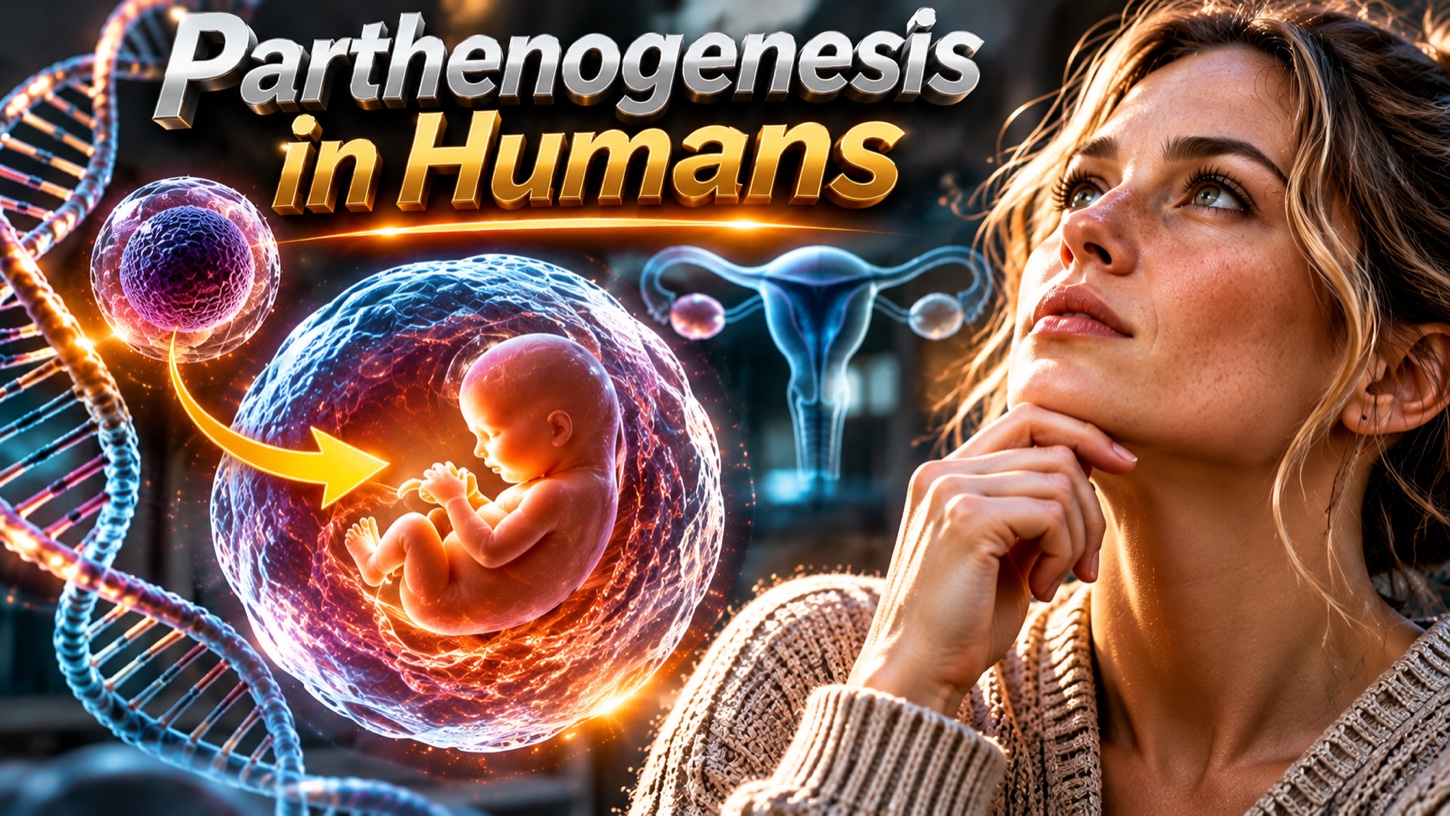
What is parthenogenesis?
Parthenogenesis is development from an unfertilised egg. In some animals it produces offspring. A familiar example is the honeybee, where unfertilised eggs can develop into males called drones. In human research, the word often describes the beginning of that process. An egg activates, divides and may progress through early stages in a dish. Researchers may call the developing result a parthenote. When you see the word in a paper, look for the endpoint. Did the egg divide once, reach a blastocyst, or produce offspring? Human blastocyst study
Normally, fertilisation triggers a series of changes that take an egg out of its resting state and prepare it for the first cell division. This is egg activation. Fertilisation also brings in a set of chromosomes from the sperm. Activation and genetic contribution are separate events. An egg can occasionally start dividing on its own, and researchers can also induce activation in a laboratory. Its first divisions tell us that development has started. The harder question is how far it can go. Documented human egg activation
Why two sets of chromosomes still aren’t enough
A typical human egg carries 23 chromosomes, as does a typical sperm. Together they usually form a cell with 46. So an obvious question is whether an egg could make up the difference by keeping or duplicating a second set of its own chromosomes. That can give a cell two sets, a state called diploidy. It still leaves an important difference in how some of those genes are regulated. Human genetic case report
For most genes, both inherited copies can be used. A smaller group follows a rule called genomic imprinting. For these genes, the copy a cell uses can depend on whether it arrived through the egg or the sperm. Chemical marks on DNA help regulate this activity. At one gene, the egg-derived copy might be quieter while the sperm-derived copy does most of the work. At another, the pattern may be reversed. The effects can also depend on the tissue and stage of development. Foundational mouse imprinting experiment, Human imprinting case study
Imagine two copies of a recipe with the same ingredients. One copy has a note saying to add a particular ingredient now. The other says to hold it back. If you inherit two copies with the same note, you still have the full ingredient list, but you can end up using too much of one ingredient or too little of another. Biologists call this a difference in gene dosage. Some imprinted genes help regulate fetal growth and the development of tissues that support pregnancy, including the placenta. An imbalance can therefore matter long after the first few cells have formed. Mouse developmental study, Experimental study of imprinting and development
There is another wrinkle. Maternal describes how a chromosome entered the developing egg, even if the egg donor originally inherited that chromosome from her own father. During the formation of eggs and sperm, many parent-of-origin marks are reset. Tracing a chromosome back to a grandfather therefore does not give it the pattern of regulation it would have acquired in sperm. Imprinting is one reason why counting chromosomes and tracing their family history can tell you different things. Foundational imprinting research
What have researchers actually seen in humans?
Unfertilised eggs can reach the blastocyst stage
A blastocyst is an early developmental structure with a fluid-filled cavity, an inner group of cells and an outer layer. In ordinary development, cells from these regions contribute to the embryo and to supporting tissues. In a study published in 2008, researchers reported that five of 30 human eggs that had never been inseminated formed the cavity characteristic of a blastocyst under laboratory conditions. That is direct evidence of how far early development can sometimes proceed without fertilisation. Five out of 30 describes that particular experiment. It gives us no estimate of how often this happens naturally. 2008 human blastocyst study
A 2026 study reported blastocysts assessed as having the expected chromosome number after artificial activation of donated human eggs from fertility treatment. You may see the term euploid in coverage of this research. It describes chromosome number. It leaves open questions about which parental copies of genes are active, whether development is proceeding normally and what would happen after implantation. The researchers monitored development in the laboratory through day seven. 2026 laboratory study
A child had some cells with only maternal DNA
In 1995, researchers reported a child with two genetically distinct groups of cells. One carried nuclear DNA from both parents. The other carried two copies of a maternal chromosome set. The authors called the case a parthenogenetic chimera. The finding is striking because it shows that cells with an exclusively maternal nuclear genome can contribute to a living human. The same child also had cells containing paternal DNA. The study could infer aspects of the child’s early development from the genetic pattern, but nobody observed those first events directly. 1995 report in Nature Genetics
This is probably the most persuasive case you will encounter if someone tells you a human parthenogenetic birth has already happened. It is a real paper, and its title really does use the word parthenogenetic. Ask what the adjective describes. In this case, it describes the ancestry of one group of cells within the child. To establish that a whole person developed through parthenogenesis, scientists would need evidence that accounts for the genetic origin of the person as a whole. 1995 genetic case report, Later human chimaerism study
Some ovarian tumours show signs of a parthenogenetic origin
An ovarian teratoma is a growth arising from germ cells, the cell lineage that produces eggs. Some contain remarkably well-differentiated tissues, such as hair or teeth. Genetic studies have found patterns consistent with a maternal germ-cell origin in some of these tumours. In one rare case, researchers studied a fetiform teratoma, a tumour whose shape resembled a fetus, and found genetic and imprinting evidence supporting an origin in a mature egg. Ovarian teratoma chromosome study, Fetiform teratoma genetic analysis
How can a growth make teeth or hair? The cells have the potential to specialise, and different parts of the growth can follow different developmental paths. A pregnancy requires those processes to be coordinated across the developing body and the tissues that sustain it. A photograph can show an uncanny resemblance. It takes pathology and genetic testing to establish what the tissue is and where it came from. Fetiform teratoma genetic analysis
What did the mouse experiments prove?
In 2004, researchers reported a mouse that reached adulthood after developing from a reconstructed egg containing two maternal chromosome sets. The experiment used genetic material from two egg cells at different stages of development and addressed an imprinting barrier. A later study produced fertile mice with two maternal genetic contributions by intervening in imprinting. These experiments strengthened the case that how genes are regulated can determine whether mammalian development succeeds. Kono and colleagues, 2004, Li and colleagues, 2018
A 2022 study came closer to the familiar idea of an offspring developing from a single unfertilised egg. After modifying imprinting in mouse eggs, researchers reported live offspring. In one experimental group, 192 blastocysts were transferred, three pups were alive at term and one reached adulthood. In a follow-up group, two of 155 transferred embryos reached adulthood. Look at both ends of that sequence. The team demonstrated that the developmental barrier can be overcome in some mice under experimental conditions. The losses between blastocyst and adulthood show how little early development alone tells us about the final outcome. 2022 single-egg mouse study
Those findings give us a reason to question any blanket claim that mammals can never develop from an unfertilised egg. They also give us a reason to scrutinise claims that humans are next. The human and mouse evidence comes from different species, different experimental conditions and different endpoints. The mouse results support a biological explanation for the barrier. They cannot supply the missing evidence for a human pregnancy or live birth. Mouse live-birth study, Human blastocyst study
How would a claim of human parthenogenetic birth hold up?
Take the strongest version of the claim seriously. Imagine a credible hospital reports a live birth and preliminary testing finds only maternal markers in a blood sample. That would be an extraordinary result and a reason to investigate. It would still leave several questions open.
- Was there a documented live birth? A positive pregnancy test, an ultrasound image and a living newborn establish different things. The published human laboratory studies establish early development and stop there. Human blastocyst study
- What was tested? Blood and other tissues can have different genetic profiles in a chimera. Testing multiple independently collected tissues would help show whether the initial result represents the whole individual. Human chimaerism study
- How thoroughly was the child’s DNA compared with the egg provider’s? A small set of matching markers can miss differences elsewhere. Genome-wide analysis would give a stronger basis for inferring that both chromosome sets came through the egg. Independently verified sample identities would also matter. Human genetic case report
- What other explanations fit the result? A maternal-only cell line, maternal cells in a sample or unusual inheritance affecting a particular chromosome can all complicate interpretation. The strongest evidence would explain the pattern across the genome and across tissues while addressing plausible alternatives. Human egg activation and uniparental inheritance case report
A reproductive researcher, a clinical geneticist and a pathologist would approach that announcement from different directions. The researcher would ask how development progressed. The geneticist would ask how parental origin was established and how representative the samples were. The pathologist would ask what the tissue shows about how it developed. Their answers have to fit together. That is why a compelling photograph, a chromosome count or a single DNA test would justify further investigation before anyone could announce a first. Human chimaerism study, Fetiform teratoma genetic analysis
Why study human parthenogenesis at all?
Human parthenotes give researchers a way to ask which early developmental events can happen with egg-derived DNA alone. Teams have also derived pluripotent stem cell lines from human parthenogenetic blastocysts. Pluripotent cells can give rise to many of the cell types found in the body. Researchers can use these lines to investigate how cells specialise and how imprinting affects gene activity. A cell line can show that individual cells have considerable developmental potential while leaving the question of whole-organism development open. Human stem cell derivation study
The ethics depend partly on the aim of the work. Studying donated eggs raises questions about consent, oversight and what donors understand about downstream use. Attempting to establish a pregnancy would introduce risks for the person carrying it and for any resulting child. Animal studies are valuable precisely because they reveal developmental failures that an early laboratory endpoint can miss. Someone reading the same mouse study to understand imprinting and someone reading it to judge reproductive safety will therefore pay attention to different results. ISSCR research standards, Mouse developmental outcomes
Frequently asked questions
Can a human get pregnant without sperm through parthenogenesis?
There is no verified human pregnancy culminating in a live birth through parthenogenesis. Unfertilised eggs have divided and reached early developmental stages, including the blastocyst stage in the laboratory. Whether a person had sexual intercourse is a different question from whether sperm contributed DNA. Assisted reproduction can involve fertilisation without intercourse. Human blastocyst study, Human fertility laboratory study
Would a parthenogenetic baby be a clone of the mother?
There is no verified human example to test. In principle, an egg normally carries a reshuffled subset of the egg provider’s chromosomes. Duplicating that set would copy the egg’s genetic selection. It would differ from copying the full pair of chromosome sets in one of the provider’s ordinary body cells. The way the egg acquired two sets of chromosomes would affect how much genetic variation it retained. Human germ-cell genetic analysis
Could scientists ever make human parthenogenesis work?
Animal experiments show that certain biological barriers can be changed. There is currently no verified human live birth to establish feasibility, let alone evidence of safety. Anyone predicting a timeline would have to account for much more than chromosome number, including the timing of gene activity, placental development, health after birth and the implications of intervening in early development. Mouse live-birth study, Human blastocyst study
The next time you see a headline about a human “virgin birth”, ask one question first. What actually developed? An egg can divide. A blastocyst can form. Some maternal-only cells can survive in a person. Each observation tells us something about human biology. A verified human live birth from an unfertilised egg alone would be a finding of its own. Human blastocyst study, Human chimaera case report